
Every November the first big southerly or afternoon thunderstorm rolls across Sydney and the phone does not stop for a week. Half of those calls are for faults that were sitting there, visible, in September. The roof did not fail in the storm. It failed months ago and the storm was the first rain hard enough to prove it.
This is the checklist we would want every customer to run before November: what fails first, how to check inside and outside without getting on the roof, what to do if it leaks mid storm, and why October is the month to book.
What Sydney storm season does to a roof
Sydney's thunderstorm season runs from about November to March: afternoon storms off the ranges with hail, gusts over 100 km/h and 30 or 40 mm of rain in half an hour. East coast lows are a different animal, often arriving in late autumn and winter with days of wind driven rain from the south east that finds gaps a summer storm never touched.
Hail cracks tiles and splits old sarking. Wind lifts capping, flashings and loose sheets, and drives rain uphill under tile laps. And a roof with blocked valleys or gutters sheds a normal shower and drowns in a storm.
What fails first
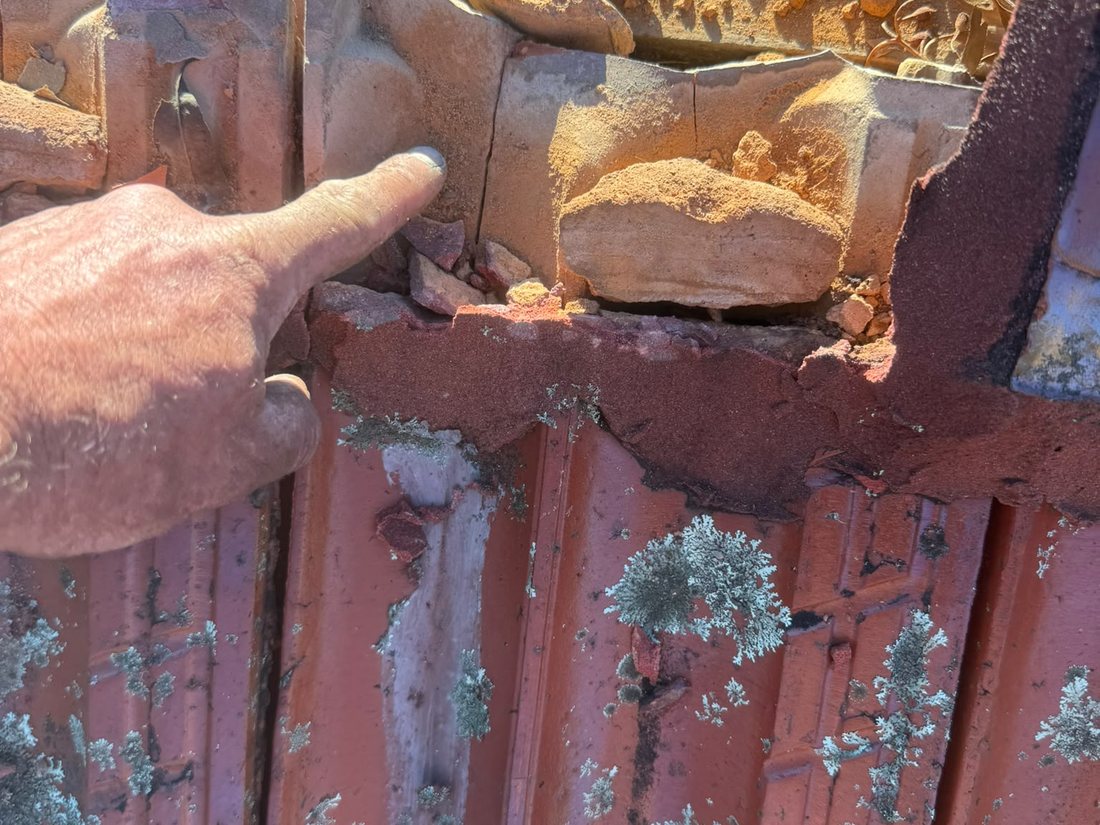
Lifted ridge capping and cracked bedding
The mortar under the ridge caps cracks with age and sun. Wind gets under a cap with no bedding and lifts it, and the rain goes straight into the cavity along the highest line of the house. This is the number one cause of the storm leaks we fix.
Blocked valleys and gutters
Leaves in a valley slow the water. In a storm the valley cannot keep up and the water rises above the iron and under the tiles either side. A blocked gutter does the same at the eave: over the back lip, into the fascia and eaves, down the inside of the wall. Both look like a roof leak from inside and neither is.
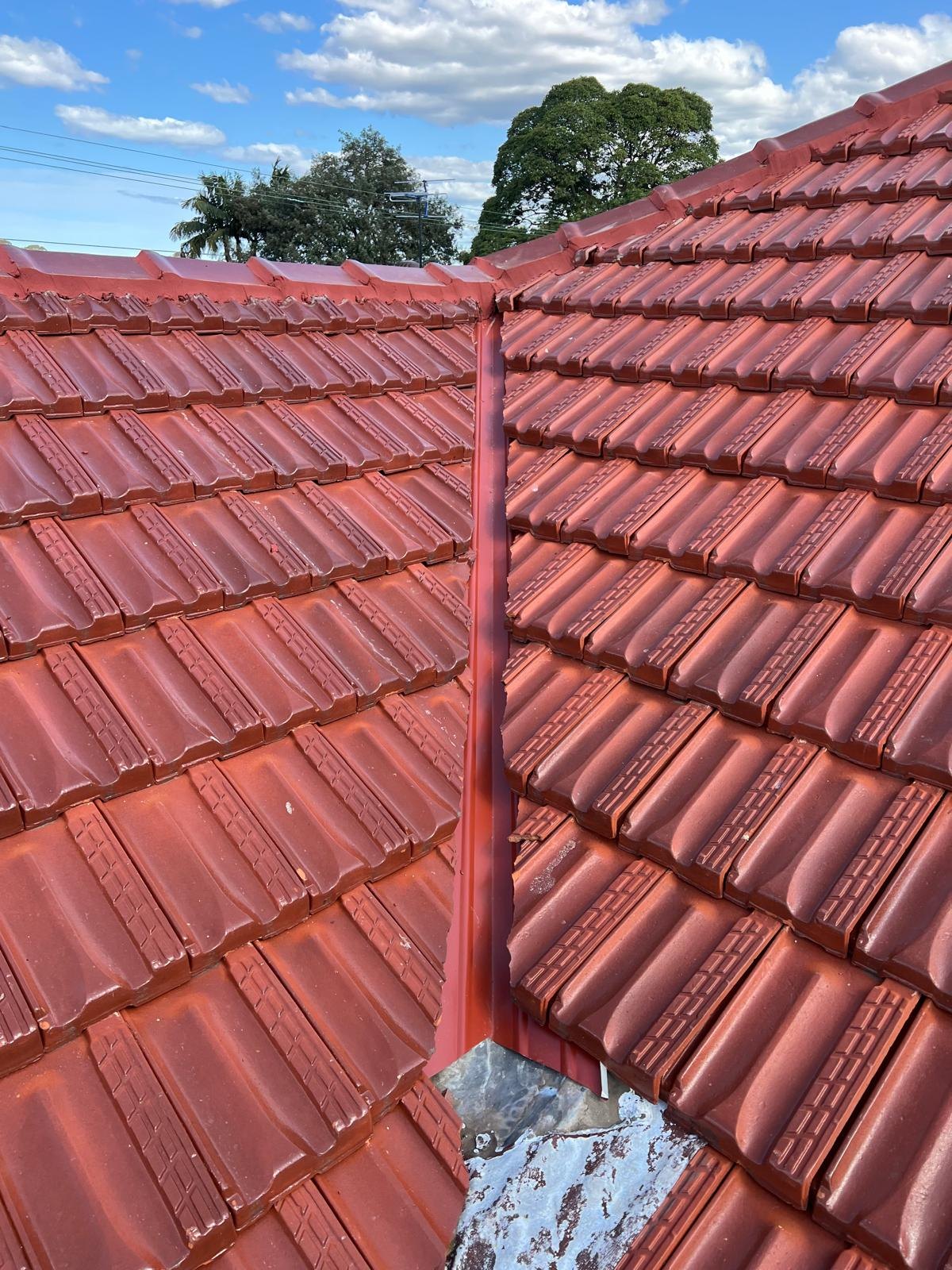
Rusted valley irons
Galvanised valley irons on roofs from the 1960s to 1980s are rusting through now. A pinhole in a valley is invisible from above because the tiles cover the edges, and it only leaks when the valley is running full, which is when a storm hits.
Loose flashings and old sarking
Flashings around chimneys, skylights, aircon penetrations and wall junctions are held by fixings and sealant that both give up. Wind lifts the edge and rain gets behind it. Under the tiles, 30 or 40 year old sarking has gone brittle and torn, or was never there, and it is what decides whether rain driven under a lap reaches the ceiling or runs into the gutter.
Branches and downpipes
A branch that rubs the roof in a breeze cracks tiles in a gale. At the other end, a downpipe that has come apart from the stormwater dumps the whole roof's run off against the footing, which is how you get a damp wall, a cracked slab and a door that will not shut.
The inside check, room by room
Walk every room with a torch, looking for anything that was not there last year.
- Ceilings. Brown or yellow rings, bubbled paint, a stain with a tide mark. A grey stain in a corner near an external wall usually points at the gutter, not the roof
- Cupboard tops. Leaks show here first because nobody looks. Run a hand along the top shelf of every built in for damp or warped board
- Light fittings. Water tracks along the ceiling and drops out at the first hole, which is the downlight. A rust mark around a trim is a roof problem and an electrical one
- The roof space. Dark stained timbers, damp insulation, daylight through the roof, torn or missing sarking

The outside check, from the ground
Binoculars and a walk around the house, nothing above ground level.
- Ridge line. Sight along it for caps that sit proud, tilt, or show gaps where the mortar should be
- Tile courses. A tile lower than its neighbours has slipped. A pale patch is a crack or a missing corner
- Valleys. Leaves visible from the ground, or rust streaks on the tiles below
- Gutters and downpipes. Sag between brackets, plants, rust at the joins, staining on the fascia from overflow, and every downpipe connected at the bottom
- Flashings. Lifted edges or cracked sealant at the chimney, skylight, walls and pipes
- Trees and penetrations. Anything within reach of the roof in a gale, and the tiles around aerials, solar and aircon units, because installers walked on them
The 12 point storm season checklist
Anything you cannot tick is a reason to book the inspection.
- Ridge and hip capping flat, no visible gaps or missing mortar
- No cracked, slipped or missing tiles visible from the ground
- Valleys clear of leaves, no rust streaks below them
- Gutters clear, level and not overflowing in rain
- Every downpipe connected at the bottom and running clear
- Flashings flat and sealed at the chimney, skylight, walls and pipes
- Tiles around aerials, solar panels and aircon units intact
- No branches touching or overhanging the roof
- No new or growing stains on any ceiling, cupboard top or cornice
- No rust marks or drips at any light fitting
- Roof space timbers and insulation dry, no daylight through the roof
- Sarking present and intact under the tiles
If it leaks during a storm
Do not get on the roof. Not to tarp it, not to look, not for any reason. Wet tiles and wet metal in a wind are where people get badly hurt, and nothing you can do up there will beat a bucket.
- Buckets and towels under every drip, and move furniture, rugs and electronics out of the way
- If water is near a light fitting or power point, switch that circuit off at the board
- If the ceiling is bulging or sagging, keep everyone out of that room. Wet plasterboard comes down without warning
- Photograph the drips, the stains and the roof from the ground if it is safe outside. Your insurer will want them
- Note the time and the wind direction. A leak that only shows in a south easterly tells us something a leak in every shower does not
- For storm damage to the house the NSW SES is on 132 500. If anyone is in danger, call 000
Then call 1300 304 162. Active leaks and storm damage go to the front of the schedule, seven days a week, through the emergency roof repairs line.
What a make safe is and what it costs
A make safe has one job: stop water getting into the house today. On a tiled roof that is slipped tiles put back, broken ones replaced, loose capping secured and a tarp over anything that cannot be closed up in the wet. On a metal roof it is lifted sheets screwed down and torn flashing refixed or covered. Blocked gutters get cleared so the water stops backing up.
Make safe work is quoted before we start. It is temporary, measured in days or weeks, because the fault is still underneath. Once the roof is dry we photograph the cause and quote the permanent repair in writing. Permanent repairs start from $700, and a typical storm leak repair runs $700 to $1,500 depending on the cause and how much the water has already damaged.
Storm damage is often claimable on home insurance, and the photo report and itemised quote are written for the assessor. The storm damage roof repairs page covers how the claim works and the door knockers to avoid afterwards. If the water was coming over the back of the gutter rather than through the roof, that is a gutter repair, and we will tell you so rather than sell you roof work.
When to book, and why October
October, for three reasons. The weather is dry enough for bedding and pointing to cure, which they will not do in a wet week in December. Roofers still have room in the diary, and after the first big storm the wait blows out from days to weeks. And anything the inspection finds gets fixed before it is tested, not after it has brought a ceiling down.
The free inspection takes about an hour, over the roof and into the roof space, with photos and a fixed written quote for anything that needs doing. If the roof is already leaking, the roof leak repairs page explains how we trace the water back to where it gets in rather than patching the stain.
We cover the whole of Sydney from Oatley. The Northern Beaches cops the east coast lows and the salt first, and the Sutherland Shire gets the hail that comes up from the south west. Both are where we are busiest from November on, which is the best argument there is for booking in October.
Related: storm damage roof repairs · emergency roof repairs · gutter repairs Sydney · roof ember protection for bushfire prone homes